Two brands, two histories, but something in common
At first glance, Repetto and Birkenstock do not seem to have much in common.
Repetto began in 1947, when Rose Repetto made her first ballet shoes in a Paris workshop near the Opéra. Her son, Roland Petit, was a dancer and choreographer.
Over the years, the house developed around classical ballet before also establishing itself in fashion through its ballet flats, notably the Cendrillon model created for Brigitte Bardot in 1956.
Birkenstock has a very different history. The German company’s origins go back to 1774. Its identity was built around functional footwear, foot support and walking comfort.
But while their aesthetics may seem worlds apart, the two brands share something: they both developed their expertise around the foot and its relationship with movement.
For Repetto, that means responding to the demands of dance. For Birkenstock, it means designing shoes for walking and everyday life.
This is precisely the connection the two houses chose to highlight in their collaboration.
Arizona, Opéra, Scala: when ballet codes meet the sandal
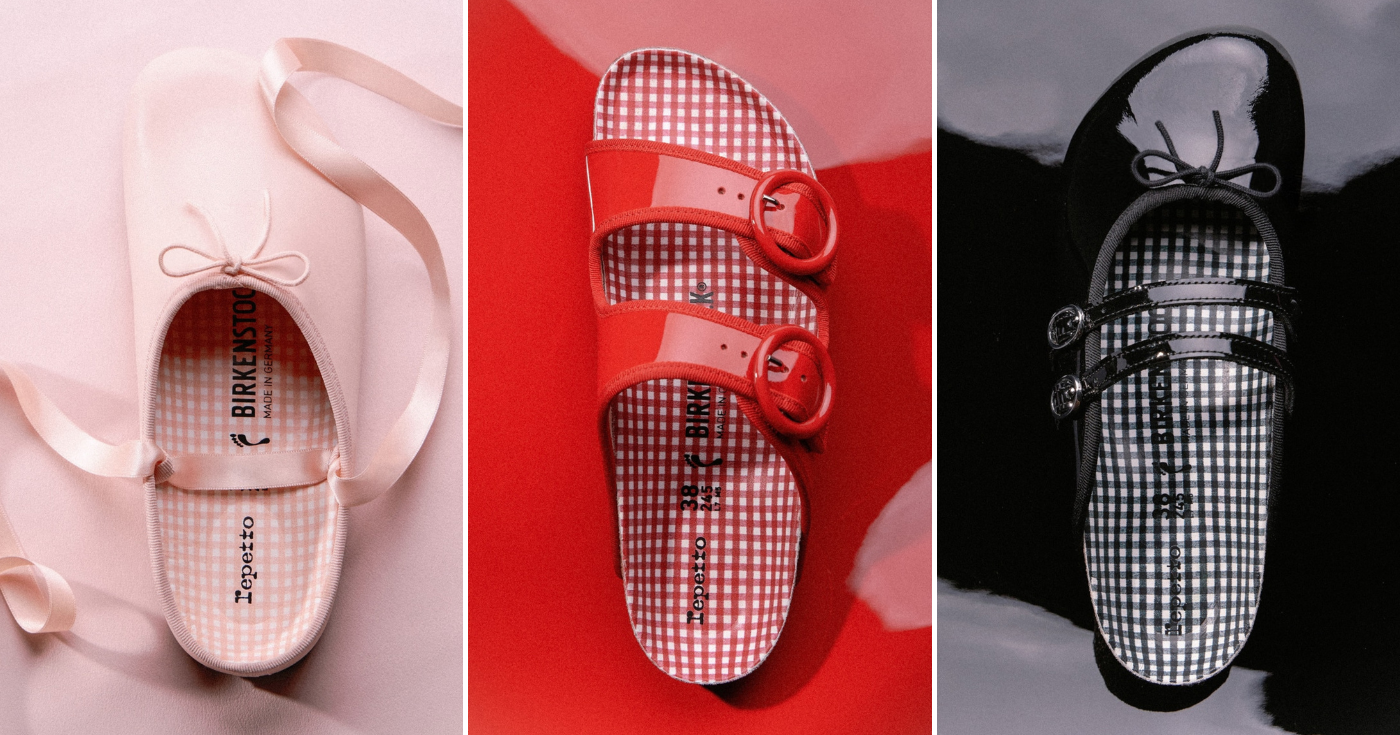
The Birkenstock x Repetto collection, launched in July 2026, is built around three models.
Birkenstock’s famous Arizona keeps its recognisable silhouette but takes on oversized round buckles and colours associated with Repetto’s world.
The Opéra stands out for its long ribbons, which can wrap around the ankle, recalling those of classical ballet shoes.
Finally, the Scala offers a more delicate silhouette, with a rounded toe, two thin straps and a bow.
Pink, red and black feature prominently in the collection. Details such as the gingham pattern on the footbeds also reference Repetto’s history and its connection with Brigitte Bardot.
What is interesting is that the brands did not simply add a little bow to a sandal to suggest dance.
They drew on several visual elements of ballet and incorporated them into shoes intended for everyday wear.
So we find the aesthetics of dance, but not necessarily its function.
These models are not shoes designed for dancing. They are fashion shoes that borrow certain codes from that world.
Did balletcore pave the way?
Balletcore has become an established presence in fashion over the past few years.
The term describes a clothing trend inspired by ballet: ballet flats, wrap tops, leg warmers, ribbons, bodysuits, powdery colours…
Clothes and accessories historically associated with dance studios now appear in ready-to-wear collections and everyday outfits.
Of course, fashion did not wait for the word balletcore to draw inspiration from classical ballet.
The Repetto ballet flat created for Brigitte Bardot in 1956 is a good example. The move from something inspired by ballet practice to an everyday shoe is hardly new.
What has changed today is, among other things, the way these references are reinterpreted, mixed and shared.
With Birkenstock x Repetto, ballet’s aesthetics meet a brand whose image was long built around functionality rather than classical elegance.
And it is precisely this contrast that makes the collaboration interesting.
Are comfort and elegance really opposites?
In the popular imagination, classical ballet is often associated with discipline, precision and a certain pursuit of perfection.
Birkenstock tends to evoke freedom of movement and everyday comfort.
The partnership between the two brands plays on that contrast.
But one thing is worth remembering: dance is not only about appearances.
Behind the elegant lines of a movement lie real physical work, years of training and considerable physical demands.
In the same way, a shoe’s comfort cannot be reduced to its appearance or its brand image.
The collaboration is therefore primarily an aesthetic and commercial meeting between two areas of expertise.
It does not mean that the physical demands of dance and walking are identical.
It does, however, show that worlds long presented as opposites can enter into a dialogue: elegance and functionality, classical codes and contemporary uses.
When dance becomes a source of inspiration for fashion
This partnership also illustrates something broader: dance does not stay in studios, on stages or in theatres.
Its gestures, clothing and visual references circulate in other fields, including fashion, advertising and popular culture.
And this phenomenon is not limited to classical ballet.
Street dance styles, for example, have also had a major influence on how people dress, advertising campaigns and fashion trends.
The difference is that brands are not necessarily interested in the practice of dance itself. They may also be drawn to what it represents visually and culturally.
This raises an interesting question for the sector.
When a brand borrows dance’s codes, does it help people discover the art form, or simply use its aesthetics to sell a product?
The two are not necessarily incompatible.
A collaboration can introduce a world to new audiences. But that does not automatically mean it directly benefits the artists, companies or organisations that keep dance alive.
A collaboration that also raises the question of accessibility
This partnership between Birkenstock and Repetto could be seen as a way of making ballet’s codes more accessible.
After all, a sandal inspired by ballet shoes can be worn by someone who has never set foot in a studio.
But we need to distinguish two things: the accessibility of an aesthetic and the affordability of a product.
This collection sits in the high-end segment. It does not necessarily turn ballet references into objects everyone can afford.
It does, however, help circulate those references among an audience that may not be familiar with classical ballet.
And perhaps that is where its main cultural interest lies.
What this collaboration tells us about dance in 2026
Birkenstock x Repetto does not revolutionise dance, and that is not its aim.
Nor does this collaboration, on its own, prove that brands are taking a greater interest in dancers or the conditions in which they work.
But it shows that the world of dance remains an important source of inspiration for creativity and fashion.
Ribbons, ballet shoes, silhouettes and references to ballet continue to appeal far beyond those who practise the art.
That is a welcome recognition of its cultural influence.
One question remains: can this visibility also benefit the people who keep dance alive every day?
Because there is still a difference between taking inspiration from dance and genuinely supporting its sector.
And that, too, deserves to be questioned behind a collaboration like this one.
Join the conversation
What do you think of this collaboration between Birkenstock and Repetto?