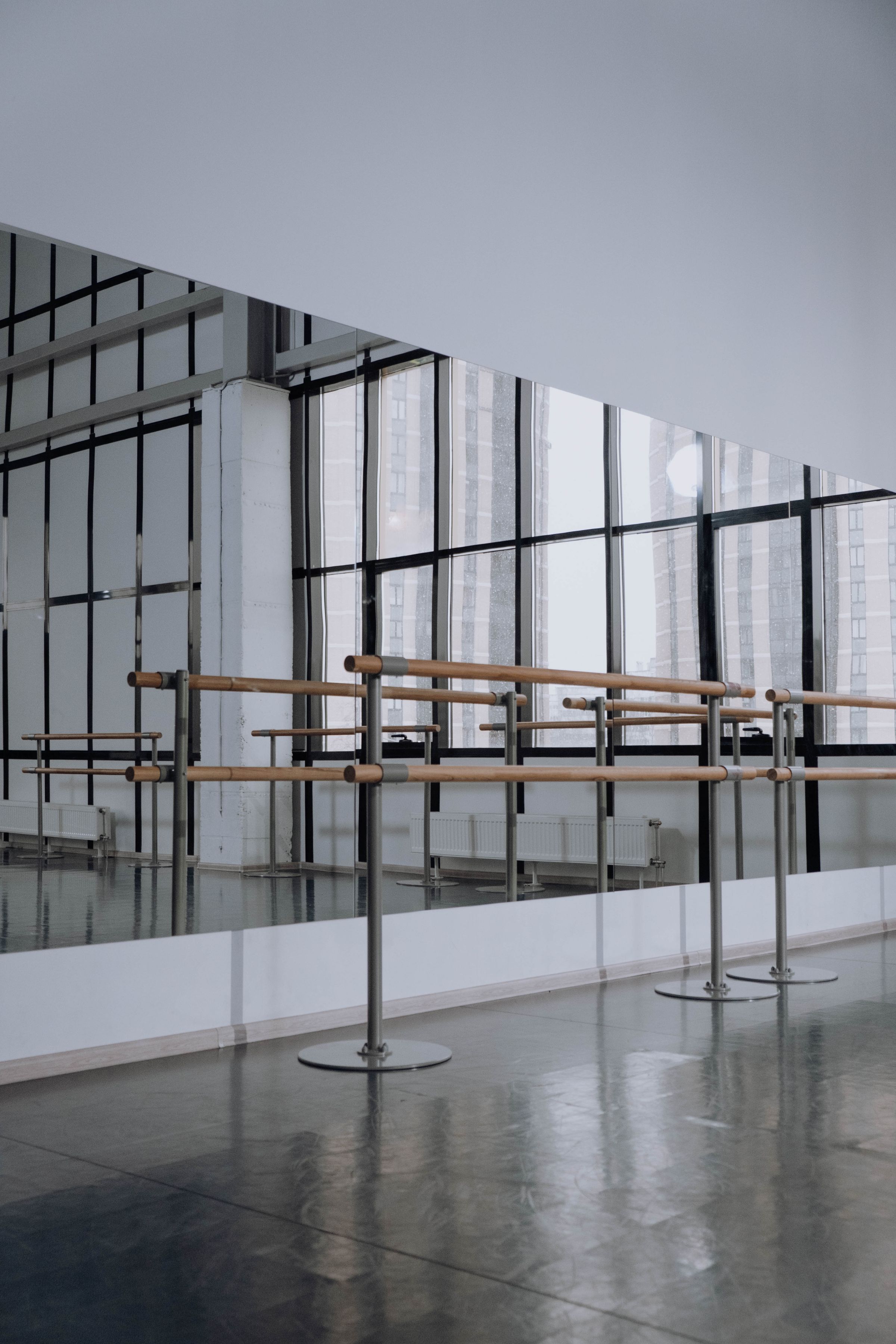
Why do we use mirrors in dance studios?
The first reason is fairly obvious: a mirror lets you see yourself dance. When you are learning a movement, it is not always easy to know exactly what your body is doing. You think your shoulders are level when one is higher than the other. You believe your arms are at the right height, then look at yourself and realise they are nowhere near where you imagined. A mirror lets you spot some of these differences immediately.
This is especially useful in styles where lines, placement and technical precision play an important role, such as ballet. It also helps you work on synchronisation, particularly when dancing in a group. And there is a practical side too: in a group class, the teacher cannot correct every person individually at every moment. The mirror becomes another tool for observing your movement and trying to adjust it, but it has its limits as well.



Watching yourself dance is not the same as feeling yourself dance
Yes, when you dance in front of a mirror, it is easy to get into the habit of checking what you are doing. Is my arm in the right place? Is my leg high enough? Do I look like the teacher? Does my movement look good? These questions are not necessarily a bad thing, and they can even be useful when you are trying to correct a technical detail. But when you spend so much time looking, you can sometimes forget to feel.
Our bodies have an essential ability, though: proprioception. This allows us to sense the position and movement of our bodies without needing to look at them. For example, you can raise your arm above your head with your eyes closed and have a rough idea of where it is. In dance, this ability is especially important because it helps us find our balance, coordinate our movements, orient ourselves in space and develop our bodily awareness.
A mirror gives us visual information, while proprioception tells us what is happening in our bodies. The two can complement each other perfectly well. The difficulty mainly arises when we become so dependent on visual feedback that we struggle to find the same reference points without it.
Join the conversation
Do you prefer dancing with a mirror or without one? And have you ever noticed a difference in the way you move?